

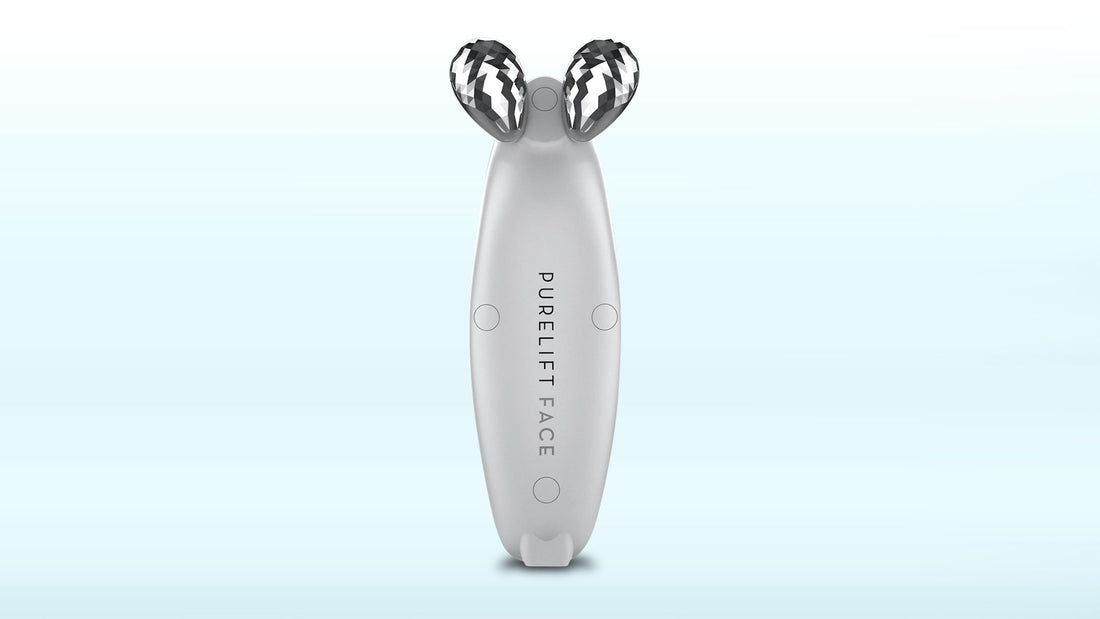
PureLift Face Review, Six Technologies in One $499 Handheld
Medically reviewed by
4 independent reviewers

Andrew Conrad Barile, PT, DPT
Doctor of Physical Therapy (DPT) | Licensed Physical Therapist (PT) | CEO and Founder, Xtreem Pulse LLC
Read bio
Dr. Andrew Conrad Barile is a Doctor of Physical Therapy and the CEO and Founder of Xtreem Pulse LLC, the engineering company behind PureLift. He earned his Doctorate in Physical Therapy from Daemen College and is a licensed physical therapist.
He brings over two decades of clinical and entrepreneurial experience across physical therapy, craniosacral therapy and medical device innovation, built on a working knowledge of human anatomy and muscle physiology.
For PureLift LAB he reviews how current is delivered across all ten levels, from sub-sensory nanocurrent and skin-level microcurrent to motor-level EMS, and how the Infuse pass fits into the same ten-minute routine.

Bertica M. Rubio, M.D.
Board-Certified Physician, Dartmouth Medical School | Medical Director, Antiaging Regenerative Medicine Clinic
Read bio
Dr. Bertica M. Rubio is a board-certified physician and Medical Director of the Antiaging Regenerative Medicine Clinic in Redlands, California. She earned her Doctor of Medicine from Dartmouth Medical School and completed her pediatrics residency at UC Irvine Medical Center.
With decades of clinical experience, she specialises in age management medicine, regenerative medicine, wound healing and growth factor therapies, and her practice integrates evidence-based medical science with advanced aesthetic treatment.
For PureLift LAB she reviews articles for medical accuracy across the whole dial, from the gentle nanocurrent and microcurrent settings through to muscle-level EMS and the Infuse pass.

Daniel Grinberg, MD, FACS
Board-Certified Otolaryngologist | Head and Neck Surgeon | Fellow, American College of Surgeons | Mount Sinai
Read bio
Daniel Grinberg, MD, FACS is a board-certified otolaryngologist and head and neck surgeon at ENT and Allergy Associates in West Nyack, New York. He earned his medical degree from Columbia University College of Physicians and Surgeons.
He completed his otolaryngology residency at New York University Medical Center, serves as Assistant Clinical Professor at Mount Sinai School of Medicine, and is a Fellow of both the American College of Surgeons and the American Academy of Otolaryngology.
For PureLift LAB he brings a wider clinical lens, connecting at-home facial stimulation from microcurrent to EMS to the anatomy underneath, with the same rigour we apply to every device specification.

Prof. Dr. med. Ivo Buschmann
Chair of Angiology, Medizinische Hochschule Brandenburg | Clinic Director, University Clinic for Angiology
Read bio
Prof. Dr. med. Ivo Buschmann is Chair of Angiology at the Medizinische Hochschule Brandenburg Theodor Fontane and Clinic Director of the University Clinic for Angiology at the Brandenburg University Hospital.
He trained at the University of Hamburg, was a Max Planck Society Fellow at the Max Planck Institute for Heart and Lung Research, and held senior consultant posts at the Charite Universitatsmedizin Berlin before his appointment as Chair in 2016.
One of Europe's leading authorities on arteriogenesis, with over 150 peer-reviewed publications and US and EU patents, he reviews for PureLift LAB how the evidence on electrical stimulation is read and where its limits lie.
Share
PureLift Face is the $499 way into the range, and for $499 you get six technologies on one handheld rather than the single current most devices at this price offer.
This review covers what Face actually does for your face and how it stands against the devices in its price range, such as:
- What each of the ten levels does, from nanocurrent to muscle-level EMS
- What three minutes on each side looks like in the mirror
- What Infusion and iontophoresis do for the serum you already own
- How Face compares with BEAR 2, Trinity+, Halo and TheraFace PRO
- When it is worth stepping up to another model, and when it is not
and many more!
By the end you will know whether Face is the right device for your face, or whether your money belongs elsewhere in the range.
Key Points:
PureLift Face costs $499 and runs six technologies on one handheld: nanocurrent, microcurrent, EMS, Infusion, iontophoresis and PDM.
Ten levels on one dial, up to 7 milliamps at 500 ohms, cleared by the FDA under record K190269 and made in Japan.
Three minutes on each side and you can see a fresher, more lifted look in the mirror; the lasting change builds over six to twelve weeks.
No proprietary gel and no app, so any water-based serum works and there is nothing to keep buying.
No clinical trial has tested a PureLift device, so everything here describes documented capability and category research.
Most people arrive at PureLift Face after searching for a microcurrent device, and the honest place to start is that Face gives you microcurrent and then keeps going.
At $499 it sits above the crowded $250 to $420 band and below the professional models in the range, and what that extra money buys is not a better version of the same current, it is a series of things the cheaper devices do not do at all.
This review works through each of those in turn, then puts Face beside the devices a shopper at this price is genuinely choosing between.
Six technologies on one dial
Face has ten levels on a single dial, and the dial is three currents laid end to end, with a second mode carrying two more technologies and a delivery architecture running underneath all of it.
Level 1 is nanocurrent, measured in billionths of an amp, which sits below the level your nerves report, so it is the setting for a sensitive evening, a first session or the thin skin around the eyes.
Level 2 is microcurrent, millionths of an amp, the gentle skin-level current that most facial toning devices are built around, and if a microcurrent routine is what you came for then Face already has it at level 2 of ten.
Levels 3 to 10 are EMS, where the current is strong enough to fire the nerve that drives a facial muscle, up to 7 milliamps measured at 500 ohms.
Then comes the Infuse pass, which is two technologies rather than one, Infusion and iontophoresis, and it is the part most people do not expect to find on the entry model.
Underneath all of it runs PDM, Pulsed Dynamic Modulation, moving the signal across 361 frequency points between 1,370 and 1,730 Hz so that minute ten does not feel like a signal your nerves have already learned.
What the muscle work does
Around forty small muscles sit under the skin of your face, held inside a connected sheet called the SMAS, and those muscles are what give your face its shape.
EMS asks them to work, and from level 3 up you can watch the cheek or the jaw answer in the mirror, which is the part no microcurrent device can show you.
In the largest facial trial of its kind, 108 women used facial muscle stimulation daily for twelve weeks, and ultrasound measured an 18.6 percent increase in cheek-muscle thickness, with a clear difference from the untreated group at six weeks and a clearer one at twelve (Kavanagh 2012).
A double-blind trial against a dummy device that looked identical found muscle thickness and bite force increased after six weeks (Chang 2020), which is the strictest test this field has.
Those are category studies using their own devices, so they show what facial muscle stimulation can do rather than what PureLift Face did for anyone in particular.
What the gentle levels do
Levels 1 and 2 are not filler, they are the settings you reach for on the days the muscle work would be too much.
Laboratory work shows that defined small currents change how skin cells behave, affecting fibroblast migration, energy production and collagen-related signalling, and small facial studies report smoother texture and softer lines (Saniee 2012).
One split-face study makes the division of labour plain: the microcurrent side improved eye-wrinkle volume and dermal density while the EMS side improved lifting measures, which is two currents doing two different jobs on one face (Kwak 2023).
Having both on one dial is what lets the routine survive a reactive week, because you turn down instead of skipping.
Infusion and iontophoresis, the Infuse pass
Most of what you put on your face stays on your face, because the outer layer of skin is a barrier and a good one.
Infusion is built on the delivery science of electroporation, where brief electrical pulses were shown to open temporary routes through that outer barrier (Prausnitz 1993) and to enhance vitamin C penetration in human skin (Zhang 1999).
Iontophoresis is the second technology in the same pass, using a gentle current to move charged ingredients inward through those routes, so opening the door and walking through it are handled separately.
On Face it is a gentle second pass, run while the skin is warm from the muscle work, and both technologies are on the $499 model rather than reserved for the flagship.
We say supports absorption and no more, because no product-specific penetration study exists and the ingredient decides most of the outcome.
Three minutes on each side
Three minutes on each side of the face, at a level where you can see the muscle answer, and the difference is visible in the mirror straight away: a fresher, more lifted-looking face, because the muscles have worked and blood is flowing.
That first effect is temporary, like the glow after a walk, and it comes back every session.
The full session runs ten minutes and switches itself off, and the lasting change follows the research clock rather than the daily one, with the first measured differences at six weeks and the larger ones at twelve.
How Face stands against its price range
The devices a shopper with $250 to $500 is choosing between are FOREO BEAR 2 at $399, NuFACE Trinity+ at $395, ZIIP Halo at $399.99, Therabody TheraFace PRO at $419.99 and Medicube Age-R Booster Pro X2 at $249.
ZIIP is the only one of the five that also runs a nanocurrent setting, and Medicube is the only one with a serum mode, and none of the five reaches the muscle.
On published output, BEAR 2 reaches 680 microamps, TheraFace PRO 500, ZIIP Halo 309 and NuFACE Trinity+ between 170 and 200, against 7,000 microamps on Face, which is about ten times the strongest of them.
The ratio matters less than what it crosses, because the useful boundary is the point where the nerve fires the muscle, and a device that stops below it can support skin quality and cannot move a muscle however carefully it delivers its current.
The running cost is the other gap: FOREO's serum is $59, NuFACE's gel starts at $35, ZIIP's gels run to $130, while Face works with any water-based serum you already own and ships with a bottle of Activator Serum to start.
Our September 2026 review of current-based home devices sold between $249 and $1,100 found no other device that combines nanocurrent, microcurrent, muscle-contracting EMS and a serum-absorption mode in one handheld.
Where Face gives ground
Face has no light, so if breakouts or fine lines are the reason you are shopping, the red and blue light on GLOW is a real reason to look further up the range.
TheraFace PRO packs more attachments into one handle, cleansing and percussion among them, and if a single multi-tool matters more to you than reaching the muscle, it is the better buy.
And no PureLift has been tested head to head against any of these devices in a trial, so the comparison rests on documented capability rather than a measured result.
Which PureLift to buy
Face at $499 gives you the compact handheld, the lightest device in the range, with all six technologies and enough room at the top of the dial to stay the right device for a long time.
Pro at $699 and Pro Edition at $799 run the same six technologies in the slim professional pen the treatment rooms use, at 7 and 7.7 milliamps, so you are choosing the shape in your hand and the headroom rather than a different job.
Pro Plus + at $899 is the strongest in the range at 9 milliamps and adds two things Face does not have, the patented diamond-faceted probe and the PDM++ waveform, the bipolar evolution of PDM that makes the top of the dial usable rather than just available.
GLOW at $999 does everything Pro Plus does and adds red light at 634 nm for lines, blue at 465 nm for mild-to-moderate breakouts and purple for both at once, so it replaces a light mask and a current device in one.
Buy Face unless the pen, the probe or the light is a specific reason for you, because the six technologies that do the work are already on the $499 device.
The regulatory and manufacturing picture
PureLift Face is cleared through the FDA 510(k) pathway under record K190269, where its maximum output of 7 milliamps at a 500 ohm load, its 1.37 to 1.73 kHz frequency range and its ten-minute session are stated.
Consumer copy always says up to, because the current that actually reaches you depends on contact, placement and your own skin.
Every model is made in Japan in an ISO 13485 facility by a company that has built facial stimulation and nothing else since 1987, and clearance is a safety review rather than an endorsement of results.
Anyone with a pacemaker or another implanted electronic device, anyone pregnant and anyone with epilepsy or a seizure disorder should not use it, and you should ask your practitioner about timing after botulinum toxin or filler.
For the sensations at each level, read what a session feels like level by level, and for the closest price-matched comparison, read PureLift Face vs FOREO BEAR 2.
Prices, competitor specifications and model figures verified on 10 September 2026 against each brand's own website and FDA record K190269. Competitor output figures for NuFACE, ZIIP and Therabody come from their FDA clearance documents, since none publishes the number on its own site.