

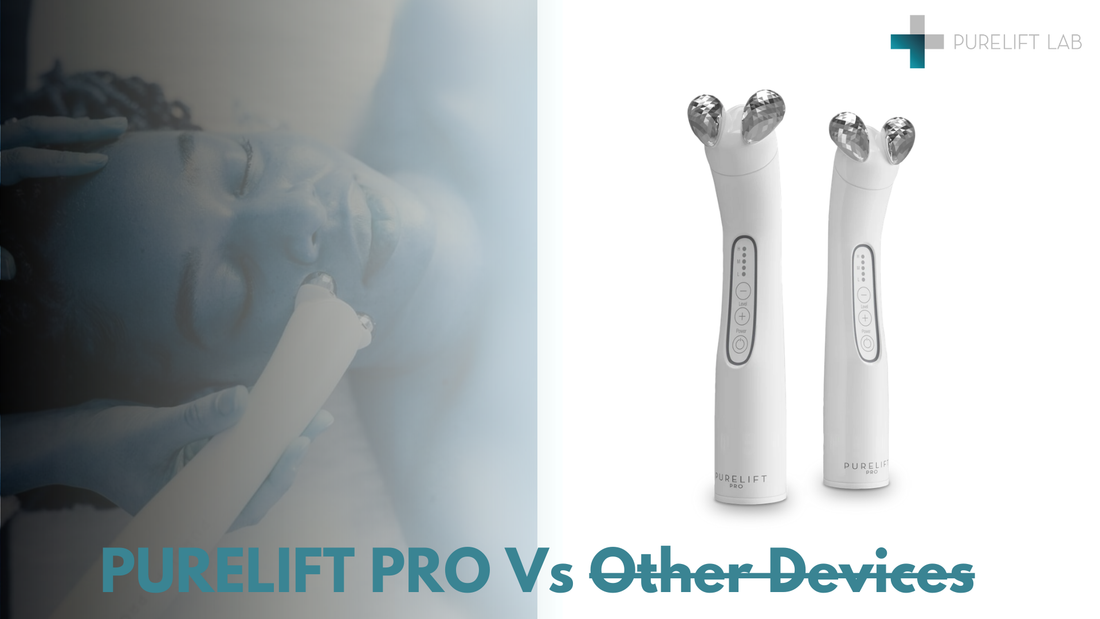
PureLift Pro or a Monthly Facial, What Each One Actually Does
Medically reviewed by
4 independent reviewers

Andrew Conrad Barile, PT, DPT
Doctor of Physical Therapy (DPT) | Licensed Physical Therapist (PT) | CEO and Founder, Xtreem Pulse LLC
Read bio
Dr. Andrew Conrad Barile is a Doctor of Physical Therapy and the CEO and Founder of Xtreem Pulse LLC, the engineering company behind PureLift. He earned his Doctorate in Physical Therapy from Daemen College and is a licensed physical therapist.
He brings over two decades of clinical and entrepreneurial experience across physical therapy, craniosacral therapy and medical device innovation, built on a working knowledge of human anatomy and muscle physiology.
For PureLift LAB he reviews how current is delivered across all ten levels, from sub-sensory nanocurrent and skin-level microcurrent to motor-level EMS, and how the Infuse pass fits into the same ten-minute routine.

Bertica M. Rubio, M.D.
Board-Certified Physician, Dartmouth Medical School | Medical Director, Antiaging Regenerative Medicine Clinic
Read bio
Dr. Bertica M. Rubio is a board-certified physician and Medical Director of the Antiaging Regenerative Medicine Clinic in Redlands, California. She earned her Doctor of Medicine from Dartmouth Medical School and completed her pediatrics residency at UC Irvine Medical Center.
With decades of clinical experience, she specialises in age management medicine, regenerative medicine, wound healing and growth factor therapies, and her practice integrates evidence-based medical science with advanced aesthetic treatment.
For PureLift LAB she reviews articles for medical accuracy across the whole dial, from the gentle nanocurrent and microcurrent settings through to muscle-level EMS and the Infuse pass.

Daniel Grinberg, MD, FACS
Board-Certified Otolaryngologist | Head and Neck Surgeon | Fellow, American College of Surgeons | Mount Sinai
Read bio
Daniel Grinberg, MD, FACS is a board-certified otolaryngologist and head and neck surgeon at ENT and Allergy Associates in West Nyack, New York. He earned his medical degree from Columbia University College of Physicians and Surgeons.
He completed his otolaryngology residency at New York University Medical Center, serves as Assistant Clinical Professor at Mount Sinai School of Medicine, and is a Fellow of both the American College of Surgeons and the American Academy of Otolaryngology.
For PureLift LAB he brings a wider clinical lens, connecting at-home facial stimulation from microcurrent to EMS to the anatomy underneath, with the same rigour we apply to every device specification.

Prof. Dr. med. Ivo Buschmann
Chair of Angiology, Medizinische Hochschule Brandenburg | Clinic Director, University Clinic for Angiology
Read bio
Prof. Dr. med. Ivo Buschmann is Chair of Angiology at the Medizinische Hochschule Brandenburg Theodor Fontane and Clinic Director of the University Clinic for Angiology at the Brandenburg University Hospital.
He trained at the University of Hamburg, was a Max Planck Society Fellow at the Max Planck Institute for Heart and Lung Research, and held senior consultant posts at the Charite Universitatsmedizin Berlin before his appointment as Chair in 2016.
One of Europe's leading authorities on arteriogenesis, with over 150 peer-reviewed publications and US and EU patents, he reviews for PureLift LAB how the evidence on electrical stimulation is read and where its limits lie.
Share
A facial and a PureLift session do different jobs on your face, so the honest answer is that a device does not replace your facialist, and a facialist does not do what the device does.
This article sets the two side by side so you can decide where your money goes, such as:
- What a facial actually does that a device cannot
- What the muscle layer needs, and why hands cannot reach it
- How the cost works out over a year
- Why consistency beats intensity for the change you want
- How to run both together without wasting either
and many more!
By the end you will know which of the two your face actually needs, or whether the answer is both.
Key Points:
A facial cleanses, exfoliates, extracts and hydrates, and it puts a trained pair of eyes on your skin, which no device does.
PureLift Pro works the muscles under the skin, at up to 7 milliamps, which massage cannot reach at any pressure.
Three minutes on each side shows a visible change today, and the lasting change comes from doing it most days for six to twelve weeks.
A monthly facial and a daily device are not competing purchases; the facial is care for the surface and the device is work on the structure.
No study has compared a PureLift with a professional facial, so this compares what each one is documented to do.
People ask this question in one of two ways, and the way they ask it usually contains the answer.
Some ask whether a device can replace the facial they book every month, and others ask whether a facial is still worth it now that they own a device.
Both questions assume the two are competing for the same job, and they are not, which is the most useful thing to understand before spending money on either.
What a facial does well
The word facial covers a wide range of appointments, and the shape of one varies by practitioner, but the common thread is care of the skin surface.
A cleanse and an exfoliation take away what has built up, an extraction clears what a home routine cannot, and a mask and moisturiser leave the skin hydrated and comfortable.
Massage is often the part people remember, and it does what a good massage does anywhere on the body, easing tension and leaving the face looking rested.
Then there is the part no device offers, which is a trained person looking closely at your skin and telling you what they see, including things worth showing a doctor.
All of that is real value, and none of it is what an electrical device is for.
What hands cannot reach
Around forty small muscles sit under the skin of your face, held inside a connected sheet called the SMAS, and those muscles are a large part of what gives a face its shape.
A massage moves the skin above those muscles and can relax them, and no amount of pressure makes a muscle contract the way it contracts when the nerve that drives it fires.
Electrical muscle stimulation does exactly that, and from level 3 upwards on a PureLift you can watch a cheek or a jaw answer in the mirror.
In the largest facial trial of its kind, 108 women used facial muscle stimulation daily for twelve weeks, and ultrasound measured an 18.6 percent increase in cheek-muscle thickness, with a clear difference from the untreated group at six weeks (Kavanagh 2012).
A double-blind trial against a dummy device that looked identical found muscle thickness and bite force increased after six weeks (Chang 2020), which is the strictest test design this field has.
Those studies used their own devices, so they show what facial muscle stimulation can do rather than what a PureLift did for anyone in particular, and no study has compared a device with a facial.
What a PureLift Pro session includes
PureLift Pro runs its technologies on one ten-level dial, at up to 7 milliamps measured at 500 ohms.
Level 1 is nanocurrent, below the level you can feel, for a reactive day or the thin skin around the eyes.
Level 2 is microcurrent, the gentle skin-level current most facial toning devices are built around, and laboratory work shows defined small currents change how skin cells behave, with small facial studies reporting smoother texture and softer lines (Saniee 2012).
Levels 3 to 10 are EMS, the muscle work described above.
Then comes the Infuse pass, run after Lift with your serum still on, and it carries two separate delivery technologies. Infusion is built on electroporation (Prausnitz 1993), where brief pulses open temporary routes through the skin's outer barrier, and iontophoresis uses a gentle current to move charged ingredients inward through those routes.
Underneath all of it runs PDM, Pulsed Dynamic Modulation, moving the signal across 361 frequency points between 1,370 and 1,730 Hz so it never repeats.
Our September 2026 review of current-based home devices sold between $249 and $1,100 found no other device combining nanocurrent, microcurrent, muscle-contracting EMS and a serum-absorption mode in one handheld, which is the point of the range rather than a detail of it.
The whole session runs ten minutes and switches itself off, and three minutes on each side is enough to see a fresher, more lifted look straight away.
Frequency is the real difference
A facial happens once a month at most for most people, and a device session happens on the days you pick it up.
That gap matters more than any comparison of what happens during a single session, because the muscle research measured its results after daily use across six and twelve weeks.
Twelve appointments a year cannot deliver that pattern whatever happens in the chair, and a device sitting unused in a drawer cannot either.
So the question to ask yourself is not which is more powerful, it is which one you will actually do often enough for it to matter.
The cost, worked through
A basic facial in the United States runs from about $55 to $110, and across all types most people pay somewhere around $110 to $175 a session, according to 2026 consumer pricing data.
Book one a month at the lower end of that range and a year costs more than PureLift Pro at $699, which is a one-off purchase with no gel subscription and no app.
That maths is genuinely favourable to the device, and it is also incomplete, because the year of facials bought you extractions, professional assessment and an hour of not being at your desk.
The fair way to read the numbers is that a device is cheap per session and a facial is not, and the two are buying different things.
Running both together
If you keep your facial appointments and add a device, use the device on ordinary days and give the skin a rest around the appointment itself.
Avoid stimulation on skin that has just been exfoliated, extracted or otherwise treated, and ask your practitioner how long to wait after your particular service, since the answer depends on what they did.
Tell them you are using a device, because they can look at your skin over months and tell you what they notice, which is a form of feedback no mirror gives you.
And if you have had botulinum toxin or filler, ask about timing before you use any electrical device, since that decision belongs to the person who treated you.
Which PureLift, if you decide on a device
Every model runs the same core technologies, so the choice is about the shape in your hand, the probe and whether you want light.
Face at $499 is the compact handheld and the lightest in the range, made for the bathroom shelf, with the same technologies at the same 7 milliamps as Pro.
Pro at $699 puts those technologies in the slim professional pen the treatment rooms use, which gives finer control around the jaw and the orbital rim, and Pro Edition at $799 is that same pen with more room at the top of the dial at 7.7 milliamps.
Pro Plus + at $899 is the strongest in the range at 9 milliamps and carries both the patented diamond-faceted probe from the 2019 design refresh and the PDM++ waveform, the bipolar evolution of PDM that makes the top of the dial usable rather than just available.
GLOW at $999 does everything Pro Plus does, PDM++ and the probe included, and adds red light at 634 nm cleared for wrinkles, blue at 465 nm cleared for mild-to-moderate inflammatory acne and purple for both at once, so it replaces a light mask and a current device in one if you were about to buy both.
Every model runs the same ten-level dial, the same 1.37 to 1.73 kHz band across 361 points and the same ten-minute session, and every model is cleared through the FDA 510(k) pathway and made in Japan in an ISO 13485 facility by a company that has made facial stimulation and nothing else since 1987.
Clearance is a safety review rather than an endorsement of results, and anyone with a pacemaker or another implanted electronic device, anyone pregnant and anyone with epilepsy or a seizure disorder should not use one.
The honest verdict
Buy the facial if what bothers you is congestion, texture, dullness or the fact that nobody has looked properly at your skin in years.
Buy the device if what bothers you is the softening along the jaw and the cheek, because that is the muscle layer and it responds to work rather than to care.
Buy both if both bother you, and treat the facial as the appointment and the device as the habit.
What you should not do is expect either one to do the other's job, because that is how people end up disappointed by two good purchases.
For what each level feels like, read what a PureLift session feels like, and for the entry model in detail, read the PureLift Face review.
Facial pricing checked on 8 September 2026 against 2026 United States consumer pricing data and varies widely by city and service. Model figures verified against the PureLift LAB store and FDA records K190269, K230506, K221443 and K243587. PDM++ is on Pro Plus and GLOW. No clinical trial has compared a PureLift device with a professional facial.